
Real Protection Program
It’s off your plate. I assess, build, implement, and train — so your workplace violence prevention system is real, not just paper, and you’re not left wondering whether it would hold up.
For Small California Employers Who Want This Handled
If you’re a small California employer, one violent incident involving a customer, client, patient, vendor, or someone connected to an employee can turn into a third‑party lawsuit that puts everything you’ve built at risk.
California’s workplace violence prevention law doesn’t exempt small employers, and “we’ve never had a problem” won’t help you if a regulator, insurer, or plaintiff’s attorney starts digging into what you did before and after an incident. Looking compliant and being protected are two different things.
This program is for small California employers that don’t just want a workplace violence policy on the shelf, but a living safety and incident management system that:
- Meets regulatory expectations
- Keeps employees and the public safer
- Stands up better if an incident ends up in court
It’s built for teams without a full‑time safety or compliance department who want it done right, and done for them.
Schedule a Real Protection Program Call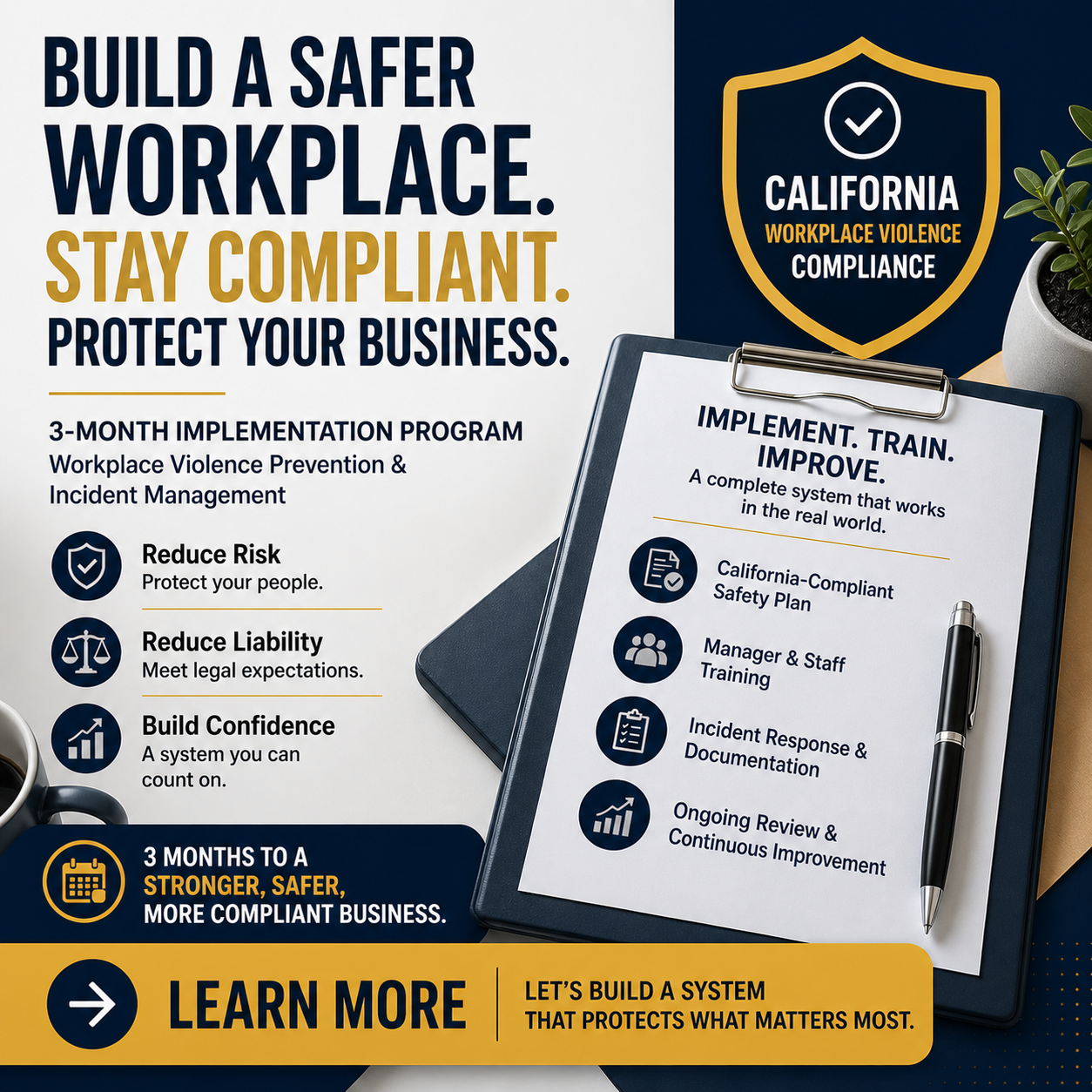






Why Small California Employers Are Quietly Exposed
California is a small‑business state:
- Roughly 717,000 California businesses have 1–20 employees, and
- Another 48,000 businesses have 20–99 employees.
Most of them:
- Have people who interact with the public, clients, customers, patients, or vendors
- Don’t have in‑house legal, HR, or security teams
- Assume they’re “too small” to worry about workplace violence laws or third‑party liability
At the same time:
- An estimated 75% of workplace violence incidents involve the public, clients, customers, patients, vendors, or people employees are personally connected to outside of work, including domestic violence and family members with drug or financial problems.
- California’s workplace violence prevention law expects every employer with public access and employees to have a real prevention, training, and documentation system in place.
That means a “small” incident at your front desk, in an exam room, on a job site, or involving someone’s partner or family member can become a third‑party lawsuit that threatens your business, your personal assets, and your reputation in the community.
What Getting It Wrong Can Cost
- Cal/OSHA citations that stack. Each missing or deficient part of your plan can be cited as its own violation: up to $25,000 for each serious violation, and more than $160,000 for each willful or repeat violation. For a small business, two or three citations is enough to do real damage.
- A 50% cash penalty on top of a workers’ comp claim, payable by you, that insurance can’t cover
- Premises liability when a customer, client, or patient is injured by another on your property: at least $250,000, and up to $1,000,000 or more depending on the severity of the injury
The safest path is simple: build a system that’s real, not just paper, before anything happens.
Call to Discuss Your Real Protection Program NeedsWhat I Do For You
I work with your leadership and key staff, and I do the work in your actual workplace:
1. Assess your actual worksite, in person.
A hands-on safety hazard assessment covering the real-world risks from the public, clients, patients, vendors, and domestic‑violence spillover, so we’re working from what’s actually there, not a generic checklist.
2. Decide what to change, and put it in place.
Remediation strategy sessions to identify the processes and environmental factors that can change to reduce hazards, then implementation of those practices with you.
3. Build your plan.
A written workplace violence prevention plan aligned with California requirements, with clear roles and responsibilities for owners, managers, and staff, plus an incident response, documentation, and complaint and investigation process you can actually run.
4. Train your people.
Managers learn what to do and say when something happens, what must be documented, and how to conduct and document internal investigations in a way that looks reasonable and defensible if it’s ever reviewed. Staff learn personal safety, strategies to avoid physical harm, and de‑escalation skills matched to your environment:
- Front desk and reception
- Site visits and field work
- Shop floor and light manufacturing
- Client‑facing offices and treatment rooms
5. Lock in a review process.
So you don’t just react and move on. You handle incidents consistently, capture lessons learned, and keep your plan and training aligned with how work is actually done.
Why This Program Is Different
This work is grounded in 30 years of investigating violent incidents and seeing how plaintiff attorneys, regulators, and courts evaluate what an organization did before and after violence occurred. I’ve seen what employers thought would protect them, and why it often didn’t:
- Policies that existed on paper but were never implemented
- “Trainings” no one could document
- Incident reports that were incomplete, inconsistent, or biased
- Investigations that looked more like box‑checking than real fact‑finding
That’s the gap between paper and real protection. The Program closes it for small California organizations, including:
- Medical and dental practices
- Law offices
- Engineering and consulting firms
- Contractors working in the field
- Light manufacturing operations
- Other small employers with public or client contact
Why This Matters Now
California’s workplace violence requirements are not optional, and they don’t just apply to big companies. Many organizations assume they’re covered because they have a general safety policy or did a one‑time training. In reality, California expects:
- A written plan that matches your actual risks
- Real implementation of that plan in day‑to‑day operations
- Training tailored to your employees’ real‑world risks, including strategies to avoid physical harm
- Timely, effective reporting, investigation, and follow‑up
- A plan that isn’t just on paper, but is actively used and updated
Compliance, done right, is not red tape. For small California employers, it’s one of the best tools you have to prevent violent incidents and protect your business if something does happen.
How the Real Protection Program Works
This isn’t a generic training series. It’s a hands‑on implementation for small California organizations that need a working safety and incident management system, not just a binder.
Stage 1: Assess & Stabilize
- In‑person hazard assessment of your worksite
- Review of your existing policies, incident history, and current practices
- Identify your highest‑risk gaps and quick wins
Stage 2: Build, Document & Implement
- Remediation strategy sessions and implementation of the changes that reduce your hazards
- Your written plan, policies, procedures, checklists, and forms
- A clear incident response and documentation process, with tools managers can actually use under pressure
Stage 3: Train, Test & Improve
- Manager training on response, documentation, and internal investigations
- Staff training on personal safety, strategies to avoid physical harm, and de‑escalation
- Scenarios based on your real‑world risks, then refinements and a review rhythm you can keep
What You’ll Have When It’s Done
- A system that’s real, not just paper: a written plan and incident process aligned with California expectations, built around your actual workplace
- Managers who know how to respond, document, and follow up when something happens
- Staff who understand expectations and have practical tools for staying safer
- A documentation trail and investigation approach that look reasonable and defensible if they’re ever scrutinized
- The confidence that what you have would hold up, and a repeatable way to strengthen it over time
Is This Program Right For You?
This is for you if:
- You’re a small California employer
- Your team interacts with customers, clients, patients, or the public
- You don’t have a full‑time security, safety, or compliance department
- You wear multiple hats (owner / HR / operations) and want this handled for you, not just explained
- You know one serious incident could seriously hurt your people and your business and want a system in place before that happens
This is not for you if:
- You have an internal security/compliance team and only want a quick refresher
- You’re looking for a free webinar with no follow‑through
- You’re not prepared to make changes to how incidents are handled
- You want to be guided through building the plan yourself. That’s the Real Protection Blueprint.
Why Work With Me On Workplace Violence Prevention
Over the last 30 years, I’ve investigated violent incidents from multiple angles:
- Bringing cases against organizations where violence occurred
- Defending individuals in criminal cases
- Conducting internal workplace investigations after threats and assaults
- Working for plaintiff attorneys to review employers’ internal investigations and evaluate whether they took their obligations seriously or just went through the motions
I understand how violence actually develops, how it can be prevented, what plaintiff attorneys and regulators look for, and what organizations are expected to do before and after an incident.
For more than a decade, I’ve provided workplace violence prevention and personal safety training to:
- Small businesses and professional practices
- Medical and legal professionals
- Engineers, contractors, and manufacturers
- Judges, court administrators and their staff
- The staff of a United States senator
The practical result for your organization is simple:
A prevention and response system grounded in real‑world cases, not theory, and designed to reduce both human harm and legal exposure.
Investment
Your Real Protection Program: $12,000 for one small employer organization with fewer than 50 employees. Travel is included.
Weigh that against the alternative: Cal/OSHA citations of up to $25,000 for each serious violation, stacked for each missing piece of your plan, a 50% penalty your insurance won’t touch, and a premises liability claim of at least $250,000 when a customer, client, or patient is injured by another on your property. The Program costs less than a single serious Cal/OSHA citation can.
Organizations with more than one location are quoted per location, based on what’s specific to each site.
Schedule a Real Protection Program Call